library(tidyverse)
library(tictoc)
library(tidyMacro)

set_theme(ftheme_tidyMacro())Replication: Beaudry and Portier (2014)
News-Driven Business Cycles: Insights and Challenges
1 Overview
This document replicates the news shock identification of Beaudry and Portier (2014) . A news shock is identified as the shock that has no contemporaneous effect on TFP but maximizes the long-run response of TFP at a 40-quarter horizon. The approach follows the mixed restriction strategy combining a zero impact restriction with a long-run maximization criterion.
2 Setup
3 Data
data("BeaudryPortier2014")

y        <- BeaudryPortier2014 |> as.matrix()
T_obs    <- nrow(y)
N        <- ncol(y)
varnames <- colnames(y)
4 VAR Estimation
p <- 2
c <- 1

var_result <- fVAR(y, p = p, c = c)
Sigma <- var_result$sigma
5 News Shock Identification
horizon <- 40

# Wold IRFs by inverting (I - A(L))
wold <- fwoldIRF(var_result, horizon = horizon)

# Lower Cholesky factor of Sigma
S <- t(chol(Sigma))

# LR-Max point estimate
struct_irf <- fmaxIRF(wold, S, var_idx = 1L)
6 Bootstrap Confidence Bands
tic()
boot_max <- fbootstrapMaxCorrected(
  y          = y,
  var_result = var_result,
  nboot1     = 1000,
  nboot2     = 2000,
  horizon    = horizon,
  var_idx    = 1,          # maximise long-run effect on TFP (variable 1)
  cumulate   = integer(0), # no cumulation (levels data)
  prc        = 68          # Match original paper
)
toc()
#> 0.283 sec elapsedfplotirfLR(
point = struct_irf,
boot_result = boot_max,
varnames = varnames,
facet_ncol = 2
) + labs(y = NULL)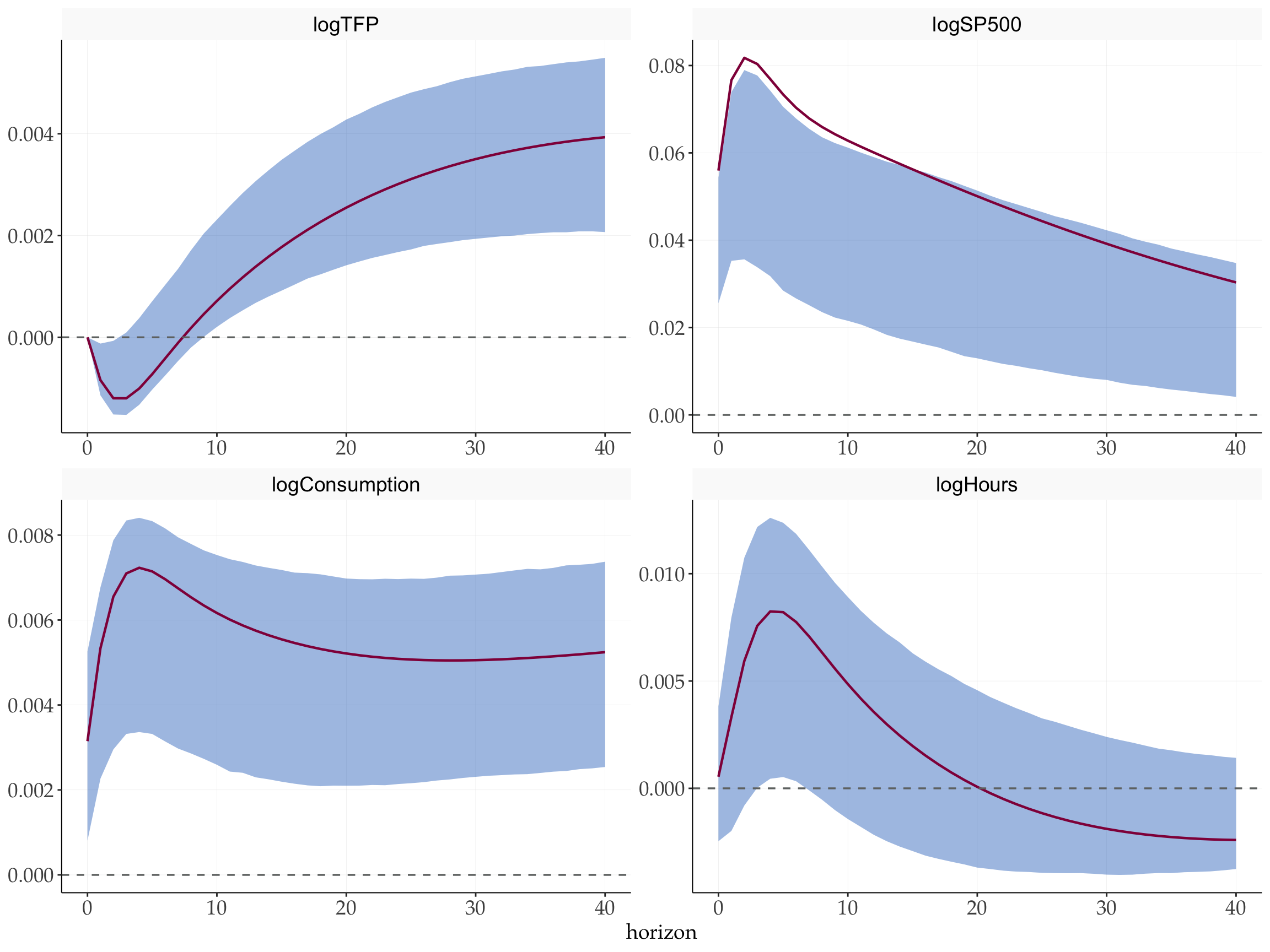
7 Compare the result to Barsky and Sims (2012)
Now we can compare the results to that of Barsky and Sims (2012) and plot IRF results.
struct_irf_uhlig <- fuhligIRF(wold, S, idx = 1L)

tic()
boot_uhlig <- fbootstrapUhligCorrected(
  y          = y,
  var_result = var_result,
  nboot1     = 1000,
  nboot2     = 2000,
  horizon    = horizon,
  idx        = 1L,        # maximise FEV share of TFP (variable 1)
  cumulate   = integer(0),
  prc        = 68         # Match original study
)
toc()
#> 0.271 sec elapsedfplotirfLR(
point = struct_irf_uhlig,
boot_result = boot_uhlig,
varnames = varnames,
facet_ncol = 2
) + labs(y = NULL)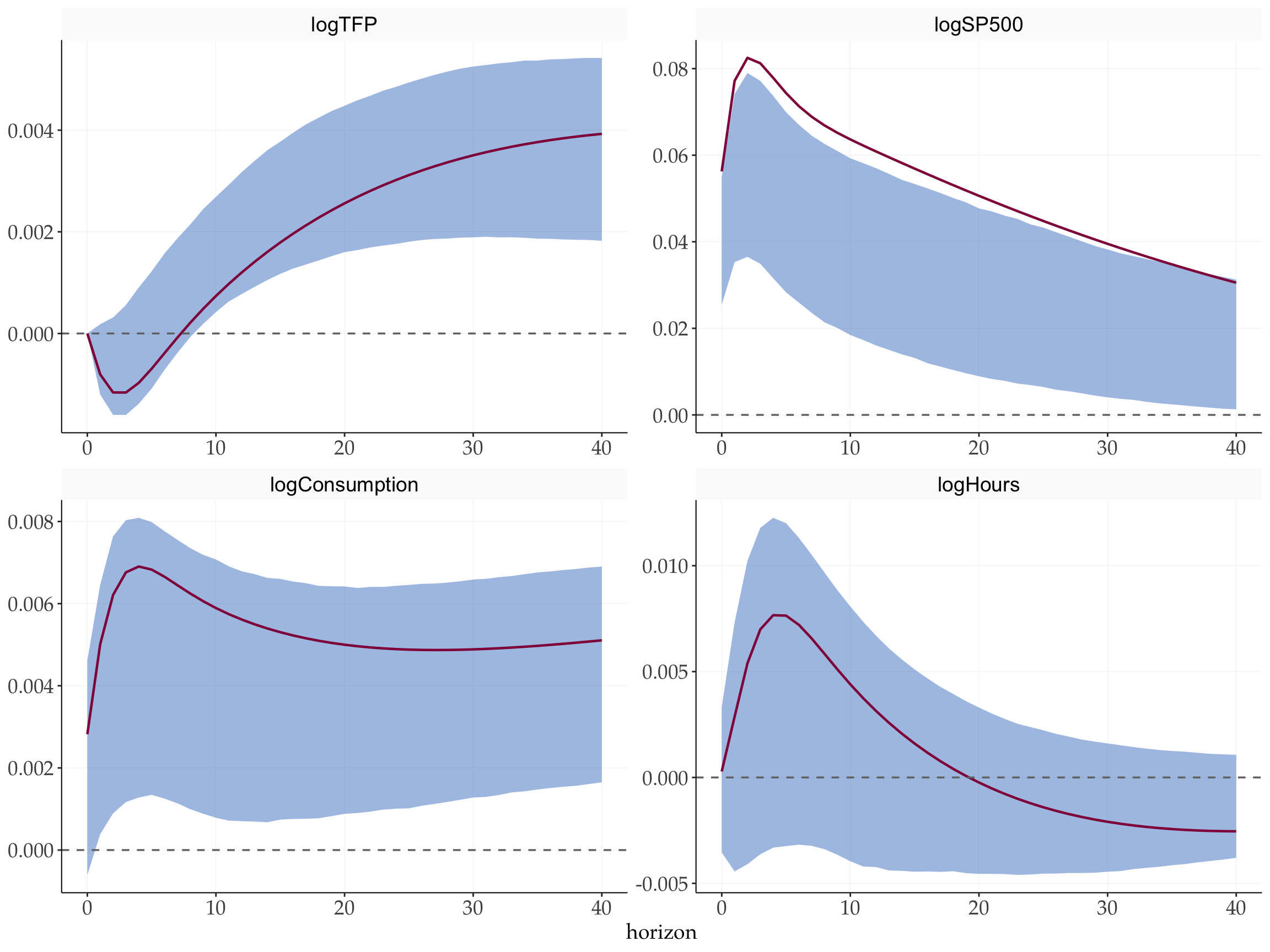
References
Barsky, Robert B., and Eric R. Sims. 2012. “Information, Animal Spirits, and the Meaning of Innovations in Consumer Confidence.” American Economic Review 102 (4): 1343–77. https://doi.org/10.1257/aer.102.4.1343.
Beaudry, Paul, and Franck Portier. 2014. “News-Driven Business Cycles: Insights and Challenges.” Journal of Economic Literature 52 (4): 993–1074. https://doi.org/10.1257/jel.52.4.993.